Your project has lore.
Your AI tools don't.
Decisions, interviews, meeting notes, research — collected in one place so every AI tool gets the full picture, with citations.
npm install -g @getlore/cliThen run lore setup to sign in
Set up Lore for me using the instructions at https://getlore.ai/docs/agent-guideYour AI walks you through it — asks for your email, sends a code, done
Your project's lore is scattered
Meeting notes in one place. User interviews in another. Architecture decisions somewhere else. Every AI tool starts from scratch — and the details that matter get lost.
Without Lore
“Users want faster exports”
With Lore
“In the Jan 15 interview, Sarah said ‘The export takes forever, I’ve lost work twice this week.’ Two other participants flagged the same issue.”source: user-interviews-jan15.md
Feed it everything. Ask from anywhere.
User interviews → code decisions
Five user interviews last week. Now every AI tool knows what users said — and cites them when making decisions.
Switch tools without losing context
Claude, ChatGPT, Cursor, Codex, CLI, TUI, and repo-local working copies — same knowledge base, everywhere.
See where your project stands
Auto-generated briefs show where your project is, where it's headed, and the evidence behind each decision.
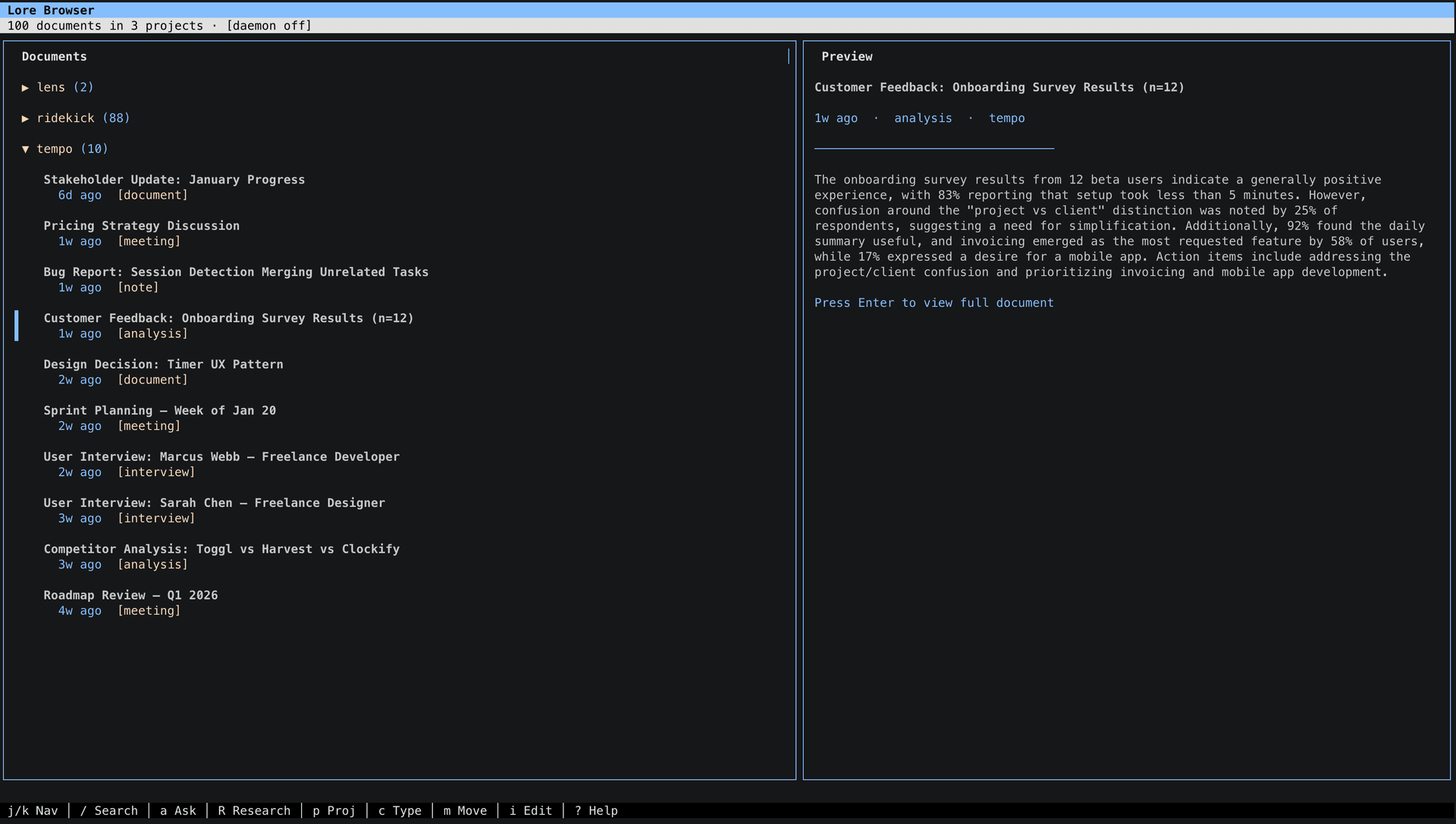
Browse your project's lore
lore browse gives you a full TUI for searching, reading, researching, and reviewing changes — no MCP client needed.
What you get
Project Briefs
Living summaries of each project — status, trajectory, key evidence. Updated automatically.
Search by Meaning
Ask questions, not keywords. Lore understands what your documents are about.
Citations
Every result links to the original source. Know exactly what was said, where, and when.
Deep Research
Cross-references all your sources to answer complex questions with cited reports.
Works Everywhere
Use MCP, CLI, the TUI, or repo-local .lore working copies for native coding agents.
Synced Everywhere
Same knowledge base on every machine via Lore Cloud. Deduplicated automatically.
Add once, search from everywhere
Feed in your meeting notes, interviews, research, decisions — everything goes into one searchable knowledge base on Lore Cloud.
Point Lore at any folder. Files are indexed automatically.
lore sync add --path ~/researchAny connected AI tool can push content. Just say “save this to lore.”
“Save this meeting summary to lore”Ingest from the command line, a file, or a pipe.
lore ingest --file notes.mdSearch from the CLI, the TUI, or any AI tool. Every result cites the original source.
lore search "what did the team decide about auth?"Get started in 30 seconds
Just your email and two API keys. Free to use — no credit card, no trial period.
Install
npm install -g @getlore/cliRun setup
Paste your API keys, enter your email, receive a one-time code — done.
lore setupStart building your lore
Add sources, push content from any AI tool, or start searching:
lore search "user pain points"
lore research "What should we prioritize?"Send instructions
Set up Lore for me using the instructions at https://getlore.ai/docs/agent-guideYour AI reads the guide, installs the package, and asks you for your email and API keys.
Paste the code
A 6-digit verification code is sent to your email. Paste it back into the chat.
Done
Your AI finishes setup and starts the background daemon. Ready to search, ingest, and research.
Connect to your tools




Add to .mcp.json in your project root, or ~/.claude.json globally:
{
  "mcpServers": {
    "lore": {
      "command": "npx",
      "args": ["-y", "@getlore/cli", "mcp"]
    }
  }
}
Settings → Developer → Edit Config. Include API keys since Desktop doesn't inherit your shell:
{
  "mcpServers": {
    "lore": {
      "command": "npx",
      "args": ["-y", "@getlore/cli", "mcp"],
      "env": {
        "OPENAI_API_KEY": "your-key",
        "ANTHROPIC_API_KEY": "your-key"
      }
    }
  }
}
Add to .cursor/mcp.json or ~/.codeium/windsurf/mcp_config.json:
{
  "mcpServers": {
    "lore": {
      "command": "npx",
      "args": ["-y", "@getlore/cli", "mcp"]
    }
  }
}Run npx @getlore/cli setup to configure API keys and sign in. This is required before tools will work.
Available tools
searchFind by meaning or keywordsget_sourceFull document contentlist_sourcesBrowse by project or typelist_projectsAll projects overviewget_briefProject context & trajectorylogLog decisions & progressingestAdd content (docs, insights, decisions)research_statusPoll async research resultsresearchAI-powered deep researchCommon questions
How is Lore different from AI memory?
AI memory compresses your conversations into short summaries and loses the details. Lore keeps the original documents — meeting notes, interviews, decisions, research — so any AI tool can cite exactly what was said, by whom, and when.
What does it cost?
Lore is currently free. You bring your own API keys — OpenAI for summary extraction, Anthropic for research. Embeddings run on-device. Re-syncing existing files costs nothing.
What can I put into Lore?
Anything that captures your project's knowledge: meeting notes, user interviews, architecture decisions, research, data exports, design docs, and more. Supported formats include Markdown, PDF, JSON, CSV, HTML, XML, plain text, and images.
Do I need to set up infrastructure?
No. Lore Cloud is fully hosted — install, sign in, bring your API keys. Everything else is handled for you.
How does multi-machine sync work?
Run lore setup on each machine. Your data repo URL is saved to your Lore Cloud account, so new machines auto-discover it. Content is deduplicated by hash.